


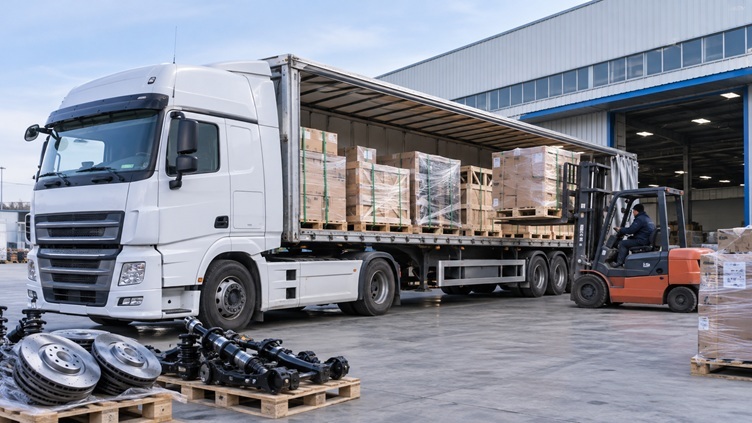
But transporting automotive parts across borders is not always straightforward. Some components are heavy and compact, while others are lightweight, oversized or easily damaged. The choice of transport method can affect delivery schedules, inventory planning and the condition of the goods when they arrive.
For importers, the challenge is not simply finding a truck or booking a railway service. It is finding a transportation solution that matches the cargo, delivery deadline and overall logistics budget.
DR Trans provides international freight services between China and Russia, with a strong focus on direct TIR road transportation. In this guide, we look at the practical considerations involved in shipping automotive parts and explain when different transport methods make sense.
Automotive parts cover a wide range of products. A shipment containing brake discs, plastic bumpers and electronic control units cannot be handled in exactly the same way.
Before arranging transportation, importers should consider the characteristics of the actual products.
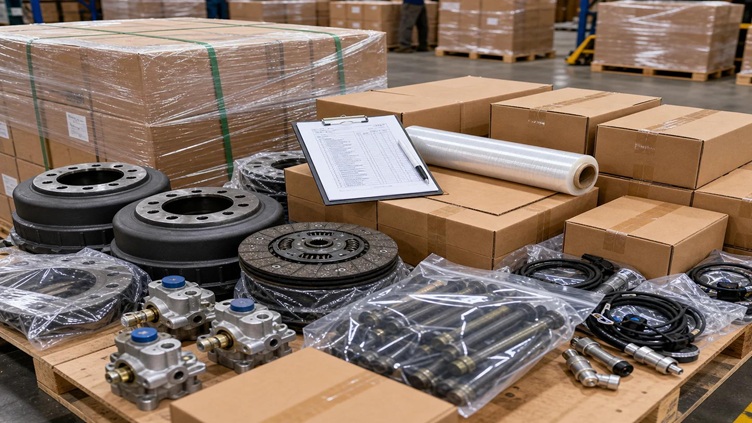
Brake discs, engine blocks, transmission components and suspension parts are relatively dense.
Their main transportation challenges include:
High pallet weight and concentrated loading pressure.
The need for stable pallets and suitable packaging.
Potential damage caused by cargo movement.
The risk of scratches or deformation when metal components come into contact.
For these products, weight distribution and proper cargo securing are particularly important.
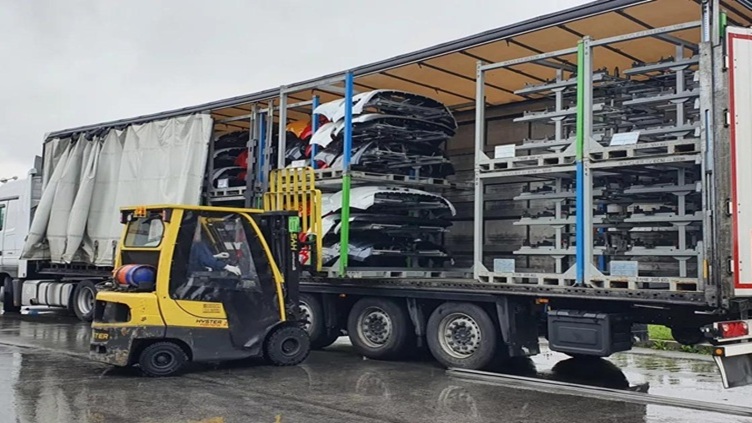
Bumpers, dashboards, interior panels and other plastic components often occupy considerable space relative to their weight.
Their packaging should prevent compression and deformation. Importers should also consider whether the available vehicle space can accommodate the cargo without placing excessive weight on the products.
For oversized body components, package dimensions may influence vehicle selection more than total cargo weight.
Sensors, control units, wiring harnesses and other electronic components require additional attention.
Depending on the product, suitable protection may include moisture-resistant packaging, anti-static materials and shock protection.
These products should also be kept separate from cargo that could cause physical damage during transportation.
The key point: Automotive parts should not all be treated as ordinary general cargo. Their weight, dimensions, packaging and handling requirements need to be assessed before loading.
The most suitable transport method depends on the shipment size, delivery deadline, cargo value and destination.
For Russian automotive importers, TIR trucking and railway transportation are two options worth comparing.
For importers who need relatively direct transportation from China to Russia, TIR road freight is a practical option.
TIR is an international customs transit system operating under the TIR Convention. It allows eligible goods to move across participating countries under a customs guarantee and sealed transport arrangements, subject to the applicable customs procedures.
For suitable automotive parts shipments, the main practical advantages include:
Direct road transportation between the loading and delivery locations.
Reduced unnecessary unloading and reloading during transit.
Sealed cargo transportation under TIR procedures.
Flexible pickup and delivery arrangements.
Shipment monitoring and coordination throughout the journey.
This can be particularly useful for automotive distributors replenishing warehouse inventory or suppliers delivering components to Russian customers with specific receiving schedules.
DR Trans provides China-Russia TIR truck transportation supported by its own fleet and logistics team.
Our indicative planning time for China-Russia TIR transportation is approximately 8–14 days. This is a reference range rather than a guaranteed delivery time. The actual schedule depends on the Chinese pickup location, Russian destination, border conditions, customs procedures and other operational factors.
Learn more about our China-Russia TIR Truck Transportation Services.
Railway transportation is another option for automotive parts importers, particularly when shipping larger quantities and working with a more flexible delivery schedule.
It can be suitable for:
Large batches of standardized spare parts.
Regular inventory replenishment.
Cargo that can be packed into containers.
Shipments where transportation cost is a major consideration.
However, the complete logistics arrangement needs to be considered.
Depending on the route, railway shipments may involve terminal handling, container transfers and additional road transportation between the railway station and the final warehouse.
For automotive parts that are vulnerable to repeated handling, importers should understand how cargo will be handled at each stage.
DR Trans also provides China-Russia Railway Transportation Services.
| Consideration | TIR Truck Transportation | Railway Transportation |
|---|---|---|
| Delivery requirements | Suitable for relatively time-sensitive shipments | Suitable for more flexible schedules |
| Transportation arrangement | Direct road delivery can be arranged | May require terminal and final-mile coordination |
| Cargo handling | Can reduce unnecessary transfers | Depends on terminal operations and route |
| Shipment volume | Full truckload and suitable consolidated cargo | Suitable for containerized shipments |
| Best suited for | Direct delivery and inventory replenishment | Larger shipments with flexible schedules |
There is no universal winner.
An importer shipping a relatively small but urgent batch of replacement parts may prefer a road solution. A distributor moving larger quantities with a flexible receiving schedule may find railway transportation more suitable.
The final decision should be based on a route-specific quotation and a comparison of the complete delivery arrangements.
Automotive importers often compare freight rates before choosing a transportation provider. However, the weight of the shipment alone is not enough to determine the final cost.
Several factors influence the quotation.
Heavy metal parts and bulky plastic components use vehicle capacity differently.
A shipment with a relatively low gross weight may still occupy most of the available trailer space.
For this reason, freight forwarders generally need both the total weight and package dimensions to assess the shipment correctly.
The distance between the supplier's warehouse and the Russian delivery address affects transportation costs.
For example, a shipment departing from northern China may require a different route arrangement from one collected in southern China.
The final destination also matters. Delivery to a warehouse in Moscow is different from delivery to a regional industrial city.
Importers with enough cargo to occupy a dedicated vehicle may consider Full Truckload (FTL) transportation.
For smaller shipments, Less-than-Truckload (LTL) arrangements may be more appropriate, subject to cargo compatibility and available capacity.
The choice should take into account the actual shipment volume, delivery schedule and handling requirements.
Fragile electronic components, oversized body parts and heavy metal assemblies may require additional protection or special loading arrangements.
These requirements should be included in the quotation rather than left until the truck arrives.
An accurate freight quotation starts with accurate cargo information.
A well-planned shipment starts at the supplier's warehouse.
Automotive parts can travel thousands of kilometres before reaching the importer. Poor preparation at the loading stage may create problems that are difficult to resolve during transit.
Here are several details worth checking.
Different products should be packed and arranged according to their physical properties.
For example:
Heavy metal parts should be placed on suitable pallets or in reinforced crates.
Plastic components should be protected against compression.
Electronic products should have appropriate protective packaging.
Fragile components should be clearly identified.
If one shipment contains several types of automotive products, the loading arrangement should take their different requirements into account.
A pallet that appears stable inside a warehouse may move when a truck brakes or travels over uneven roads.
Before departure, check that:
Pallets are in good condition.
Packages are properly secured.
Heavy cargo is distributed appropriately.
Suitable straps and edge protectors are used.
Empty spaces are controlled to reduce cargo movement.
Metal components can be vulnerable to moisture and condensation.
Depending on the product and packaging, protective film, moisture-resistant wrapping or suitable desiccants may be necessary.
This is particularly relevant when shipments pass through regions with significant temperature changes.
Transportation arrangements and customs preparation should be considered together.
Automotive components may fall under different HS codes depending on their function, construction and intended use.
For example, a brake assembly, an electrical control unit and a plastic body component may have different customs classifications and regulatory requirements.
Common documents and information required for international shipments may include:
Commercial Invoice.
Packing List.
CMR consignment note for applicable road shipments.
Accurate product descriptions and HS codes.
Certificate of Origin, when required.
Relevant conformity documents or declarations, depending on the product.
Importers should pay particular attention to product descriptions.
Using a general description such as "automotive spare parts" for every item may not provide enough information for customs classification.
The importer should confirm the applicable customs requirements and product conformity obligations before dispatch.
For additional information about the international customs transit framework, see the UNECE TIR Convention.
It is important to understand that TIR facilitates international customs transit. It does not replace Russian import customs clearance or remove applicable product compliance requirements.
When choosing a logistics provider, importers should look beyond the initial freight quotation.
A few practical questions can help identify whether the provider is suitable for regular automotive parts transportation.
Can the provider handle different types of automotive cargo?
Heavy metal components, oversized plastic parts and sensitive electronics may require different loading and transportation arrangements.
Does the provider have its own transportation resources?
Ask whether the company operates its own fleet or relies entirely on external carriers. This can affect transportation coordination and operational control.
How is cargo monitored?
Importers should understand how they receive shipment updates and who they can contact if the delivery schedule changes.
Can the provider coordinate customs documentation?
Accurate cargo descriptions and transportation documents are important for cross-border shipments. The forwarder should be able to coordinate the relevant procedures with the responsible customs specialists.
Is the delivery arrangement clear?
Before confirming an order, clarify the pickup location, destination, transport method, estimated transit time and delivery responsibilities.
For businesses importing automotive components regularly, a consistent transportation partner can make inventory planning easier.
DR Trans focuses on international freight transportation from China to Russia and other destinations, with particular experience in TIR road freight.
Our transportation services are supported by our own truck fleet and logistics coordination team.
For suitable automotive parts shipments, we can help arrange:
Direct China-Russia TIR truck transportation.
Full Truckload and suitable Less-than-Truckload arrangements.
Pickup and delivery coordination.
Loading and cargo securing arrangements.
Shipment monitoring and transportation updates.
Customs documentation and clearance coordination.
Our experience with industrial cargo also gives us practical experience in handling heavy, palletized shipments.
One example from our previous operations involved transporting 22 tons of building hardware from Handan, Hebei Province, to Yelabuga, Russia.
The shipment covered nearly 8,000 kilometres and was delivered door to door in 11 days.
During loading, the team used heavy-duty ratchet straps, edge protectors, dunnage bags and shrink wrapping to help keep the pallets stable throughout the journey.
Although this was a building hardware shipment rather than an automotive parts order, the same loading principles are relevant to heavy metal automotive components.
You can read more about this operation in our 22-Ton Hardware Shipment Case Study.
For automotive parts importers, the important lesson is that transportation planning should begin before the vehicle leaves the supplier's warehouse.
Every automotive parts shipment is different.
A truck carrying brake discs and suspension components has different loading requirements from one transporting plastic bumpers or electronic assemblies.
To help us assess your shipment, please prepare the following information:
Product name and description.
Total gross weight.
Number of packages or pallets.
Dimensions of each package.
Pickup city in China.
Delivery city in Russia.
Expected shipping date.
Any special handling or packaging requirements.
The DR Trans team can review these details, assess suitable transportation arrangements and provide a quotation.
If you are planning to import automotive parts from China to Russia, contact DR Trans to discuss your shipment.
Submit your cargo information through our inquiry page and receive a quotation response within 15 minutes.

 IPv6 دعم الشبكة