


When goods arrive at a warehouse, they do not always need to stay there. In some logistics operations, cargo is unloaded from one vehicle, sorted, and loaded onto another truck almost immediately. This process is known as cross-docking.
Cross-docking in logistics is commonly used by distribution centers, retailers, manufacturers, and freight companies that need to move goods between different destinations without keeping them in storage for long periods.
For businesses handling regular shipments, this approach can make a difference in both delivery planning and warehouse costs. However, it also requires good coordination between incoming shipments, warehouse staff, and outbound transportation. If one part of the process falls behind, the entire operation can be delayed.
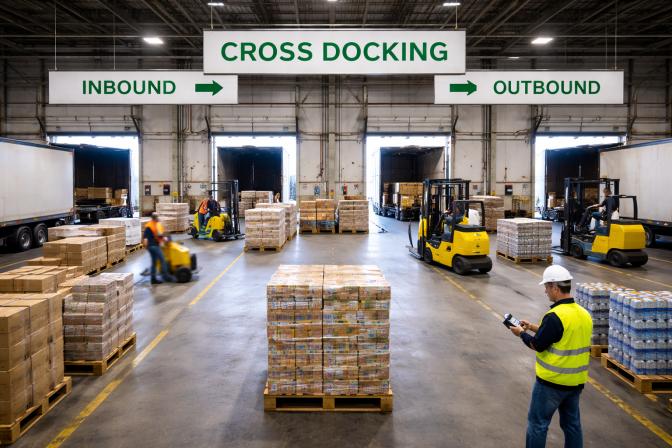
Cross-docking is a warehouse operation in which incoming goods are transferred directly to outbound transportation, with little or no long-term storage.
Think of a distribution center receiving several trucks in the morning. Each truck carries goods for different customers or destinations. Instead of putting everything into warehouse storage, workers unload the cargo, check the shipment details, sort the goods, and move them to the appropriate loading areas.
A second group of trucks then collects the sorted shipments and takes them to their next destinations.
That is the basic idea behind cross-docking.
The main difference from traditional warehousing is what happens after unloading. In a conventional warehouse, goods are usually stored until an order is ready. With cross-docking, the next delivery stage is often arranged before the cargo arrives.
This is why shipment information and transportation schedules matter so much.
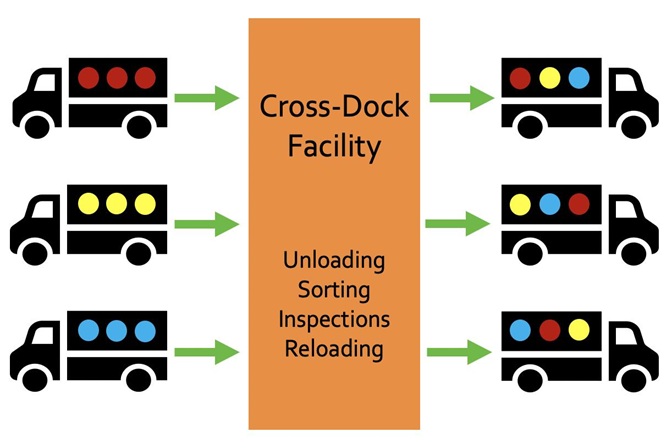
A cross-docking operation may look simple from the outside, but several things need to happen in the right order.
The process starts with incoming transportation. Suppliers or transport companies deliver goods to a designated cross-docking facility.
Ideally, the warehouse already knows what is arriving, how many packages to expect, and where each shipment needs to go. This information helps staff prepare the receiving area and arrange the next vehicles.
Without advance planning, workers may have to spend additional time identifying cargo and deciding where it should be sent.
Once the vehicle reaches the loading dock, the cargo is unloaded.
Workers check the number of packages, shipping labels, and visible packaging conditions. This is also the stage where missing packages or damaged cartons should be recorded.
The inspection does not necessarily involve opening every package. The level of checking depends on the shipment, customer requirements, and warehouse procedures.
After receiving checks, the cargo is separated according to its next destination.
For example, a warehouse may receive goods from five different suppliers. Some shipments are intended for Moscow, others for Saint Petersburg, and the rest for regional distribution centers.
Workers sort the goods into the corresponding groups so that each outbound vehicle receives the correct cargo.
In some operations, shipments from several suppliers are combined into one larger load. In others, a large incoming shipment is divided into smaller deliveries.
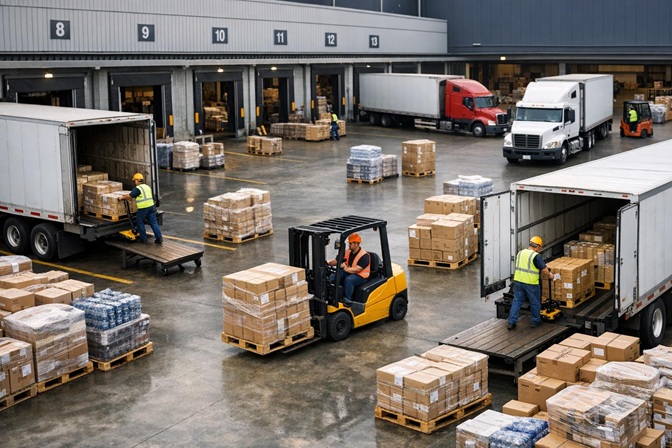
Once sorting is complete, the cargo is moved to the appropriate loading area.
The warehouse team checks the loading plan, arranges the packages, and makes sure that the correct goods are assigned to each vehicle.
The next transportation stage may involve full truckload (FTL), less-than-truckload (LTL), regional delivery, or another freight service.
At this point, timing becomes particularly important. If the outbound truck arrives too early, it may have to wait. If it arrives too late, the cargo may remain at the warehouse longer than planned.
After loading and checking the shipment documents, the outbound vehicle leaves the facility.
The cargo then continues to a regional warehouse, distribution center, retailer, or final consignee.
For the operation to run smoothly, the warehouse and transport provider need to keep each other informed about loading progress and any changes to the schedule.
Not every cross-docking operation follows exactly the same arrangement. The method depends mainly on when the destination is decided and how the cargo needs to be distributed.
Pre-distribution cross-docking
In this arrangement, the final destinations are known before the cargo arrives. Workers already have instructions on how to separate the shipments, so the warehouse mainly handles receiving, checking, and transferring goods.
This is useful when customer orders and delivery plans have been confirmed in advance.
Post-distribution cross-docking
Here, the final allocation is decided after the goods reach the warehouse.
This gives businesses more flexibility when orders or delivery requirements change. However, the warehouse needs accurate shipment information and enough time to organize the cargo.
Consolidation cross-docking
Several smaller shipments are combined into one larger load.
For example, goods from different suppliers in China may be collected at one facility and combined before being transported to the same destination. This can help businesses make better use of available truck space.
Deconsolidation cross-docking
This works in the opposite direction. A large incoming shipment is separated into smaller consignments for different customers or delivery locations.
It is often used when goods arrive at a central distribution point and need to be sent to several regional destinations.
For companies with regular cargo movements, keeping goods in storage is not always necessary. Sometimes, the real challenge is getting shipments from one transportation stage to the next without unnecessary waiting.
Cross-docking can help in several ways.
Less time spent in storage
Goods do not need to go through the full storage and retrieval process. This can reduce warehouse space requirements and inventory handling costs.
Faster distribution
When the next vehicle and destination are arranged in advance, cargo can move through the warehouse with fewer delays. This is particularly useful for businesses that replenish stock regularly.
Fewer handling operations
Every time cargo is moved, loaded, or unloaded, there is a chance of packaging damage or handling mistakes. Reducing unnecessary movements can help lower these risks.
Better use of truck capacity
Combining smaller shipments heading to the same destination can improve vehicle utilization. Businesses that do not have enough cargo for a full truck may find this arrangement useful.
More organized distribution
Instead of arranging every shipment separately, businesses can use a central facility to sort and redirect cargo according to delivery requirements.
Of course, these benefits are not automatic. They depend on how well the warehouse and transportation schedules are managed.
Not necessarily. The two methods solve different problems.
A traditional warehouse is designed to hold inventory until it is needed. This is important for businesses that maintain stock, deal with seasonal demand, or cannot predict exactly when customers will place orders.
Cross-docking is more suitable when goods already have a clear destination and can move to the next transportation stage without spending much time in storage.
| Point of comparison | Cross-Docking | Traditional Warehousing |
|---|---|---|
| Main purpose | Transfer and distribute cargo | Store and manage inventory |
| Storage period | Usually short | Can be long |
| Main operations | Unloading, sorting, reloading | Receiving, storage, picking, dispatch |
| Scheduling | Requires close coordination | More flexibility in dispatch |
| Suitable for | Regular, planned cargo flows | Inventory-based operations |
For example, a retailer receiving confirmed orders from several suppliers may benefit from cross-docking. A business importing products months before the selling season may still need traditional warehouse storage.
The choice should depend on the actual distribution plan, not simply on which method appears faster.
Cross-docking reduces some warehouse operations, but it also leaves less room for scheduling mistakes.
One common problem is a delay in incoming transportation. If a truck arrives several hours later than expected, the outbound vehicle may already have left or may need to wait.
Incorrect shipment information can cause similar problems. A package assigned to the wrong destination may have to be unloaded and sorted again, adding time and handling costs.
There is also the question of cargo suitability. Fragile products, oversized shipments, temperature-sensitive goods, and cargo requiring special inspection may need additional handling or temporary storage.
Before choosing cross-docking, businesses should consider:
Whether inbound and outbound schedules can be coordinated.
Whether shipment labels and documents are accurate.
Whether the warehouse has suitable loading and sorting equipment.
Whether the cargo can be transferred without additional storage.
Whether there is a backup plan for delayed vehicles or unexpected shipment problems.
A well-organized cross-docking operation depends on preparation before the cargo even reaches the warehouse.
In international freight transportation, cargo often passes through several locations before reaching the consignee. It may be collected from different suppliers, consolidated at a logistics facility, transferred to long-distance transportation, and distributed again near the destination.
Cross-docking can be used at some of these transfer points to organize cargo for the next stage.
Take shipments from China to Russia as an example. Goods from different Chinese suppliers may first be collected and sorted at a logistics facility. Depending on their destination and transportation arrangements, they can then be assigned to suitable outbound vehicles.
For companies arranging China-Russia road freight, the choice of route, vehicle capacity, customs arrangements, and delivery schedule still needs to be considered separately.
You can learn more about China-Russia road transport services and the available international freight forwarding services offered by DR Trans.
It is also worth clarifying that cross-docking and TIR are not the same thing. Cross-docking describes how goods are transferred through a warehouse, while TIR is an international customs transit system used for cross-border cargo transportation. They can be part of the same logistics chain, but they address different operational requirements.
Cross-docking is useful when goods need to keep moving and there is no real reason to leave them in storage for an extended period.
It can simplify distribution, reduce unnecessary handling, and help businesses make better use of transportation capacity. But it only works well when shipment information is accurate and incoming and outgoing vehicles are properly coordinated.
For importers and companies working with international suppliers, understanding cross-docking can help when comparing warehouse arrangements and planning the movement of goods.
Planning an international shipment?
DR Trans can help you assess your transportation requirements and choose a suitable freight arrangement. Send us your cargo details, pickup location, destination, weight, and volume through our contact page.
Our team will respond to your inquiry within 15 minutes.

 IPv6 دعم الشبكة